Power cut
What to do when the lights go out. On the computer you can have a notification come up as soon as the power is back or the battery is nearly empty.
Note: the programme, the guides and the first aid on the stick are in Dutch. The map shows the Netherlands and Belgium. The library contains 5 Dutch-language, 32 English-language and 10 reference works in six other languages. The translator works between Dutch and 13 other languages.
The Dutch government advises being prepared for at least 72 hours, with water, food, cash and other essential items at home. With this stick, your family goes through a checklist for the emergency kit, works out what you need and fills in an emergency plan together. Without internet, without an account and without a subscription.
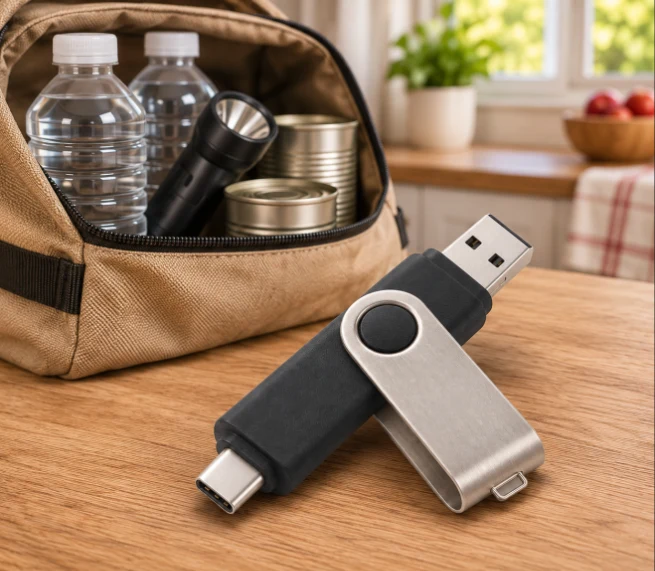
One stick costs €99, a one-time payment including VAT. If you want to give one to grandma and grandpa or to the neighbours too, a pack of 3 for €249 or of 5 for €399 is cheaper.
Free shipping to the Netherlands and Belgium, 1 to 3 working days. Ordered before 22:00 on a working day, shipped the same day. 14 days to change your mind.







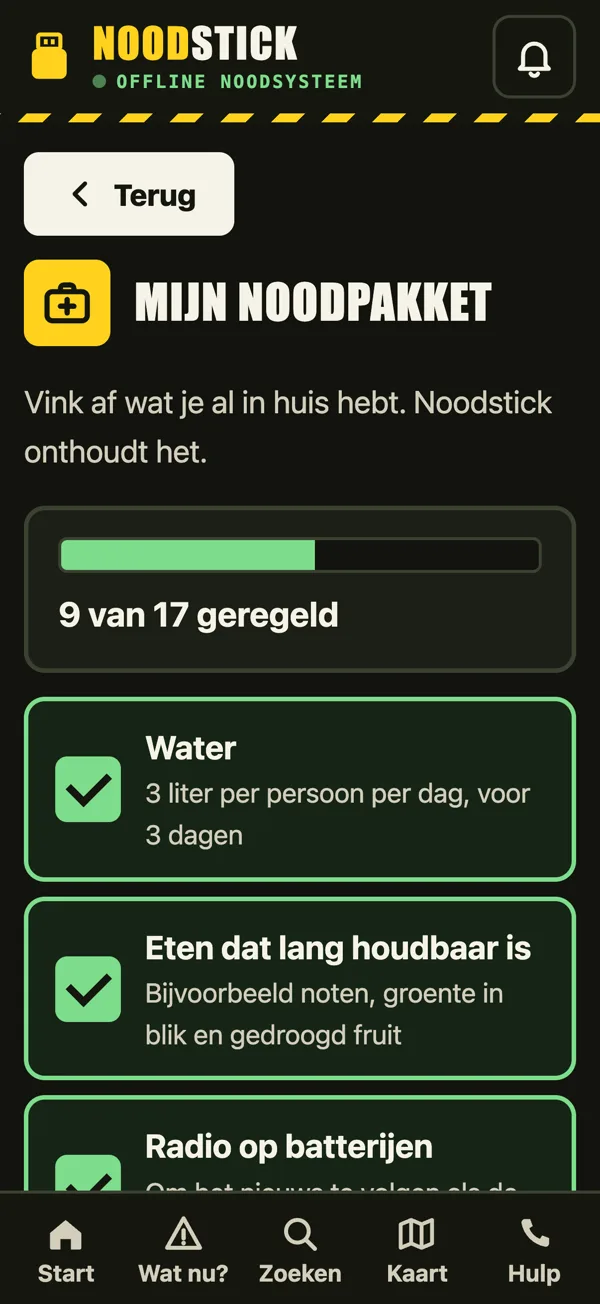
The checklist on the stick has 17 points and is based on the official Dutch emergency advice. That advice mentions water, food, cash and other essential items:
Plug the stick into the computer and open the checklist. Ask the children to look along: what do we already have, what are we still missing?
The calculator works out water and cash for you. A family with two adults and two children needs 36 litres of water and €200 in cash for 72 hours.
Get what is missing and tick it off. That way you can see at a glance whether the emergency kit is complete.
Fill in step by step who lives at home, where you meet up and who you call. Print it out and hang it in a fixed place.
When the power goes out or the siren sounds, you don't want to have to work out at that moment who picks the children up from school. An emergency plan records that in advance. The programme asks you step by step: who lives here, where you meet up if you lose each other, who you call, who needs extra help and which medicines are needed.
Then print the plan. A piece of paper on the fridge also works if no screen can be used. Update it as soon as something changes, for example when grandma moves in with you or when there is a new GP.
The programme, the guides and the first aid are in plain Dutch, with big buttons and large letters. That way a parent can find things quickly, and a primary school child can read along.
The stick holds 20 emergency guides. A few that families often open first:
What to do when the lights go out. On the computer you can have a notification come up as soon as the power is back or the battery is nearly empty.
What it means and what you do then. On the stick you can also see which station to tune the radio to in your region.
What to do when there is a fire, plus a separate guide on a fire-safe home. Good to go through together with the children.
What to think of for the youngest and for the dog or cat if you are left to fend for yourselves for a few days.
Besides the emergency kit and the emergency plan, the 64 GB stick has more on board.
23 lessons with drawings and photos, plus 7 lessons made especially for home. Each lesson has a source, and there is a rhythm button for CPR.
An encrypted vault for copies of passports and other documents, with a password you choose yourselves.
Find hospitals, pharmacies, AEDs and drinking water points near you, without internet.
Alongside the full Dutch encyclopedia with pictures there is an encyclopedia for children. Handy for when there is no internet for a few days.
The stick starts on a computer with Windows, Mac or Linux, without installation. The checklist and the emergency plan work in the full programme on the computer. On your phone or tablet you can open, among other things, the map per province and the first aid. Test beforehand on your own device.
A computer or phone needs power. A power bank or a charged laptop battery is enough, but you need to have one at home yourselves. So put it on the checklist straight away. The stick does not replace a phone, nor 112.
The official Dutch advice is to be prepared for at least 72 hours with water, food, cash and other essential items. The checklist on the stick has 17 points, based on that advice, so you can go through it together.
At least 3 litres per person per day. For a family of four that is 36 litres for three days. The calculator on the stick works it out for your own family.
For 72 hours, €70 per adult and €30 per child. The calculator adds it up for you.
The programme guides you step by step: who lives here, where you meet up, who you call, who needs extra help and which medicines are needed. Then you print it out.
No. The stick is the digital add-on to your family's emergency kit: checklist, calculator, emergency plan, guides and reference. Water, food and cash you store at home yourselves, with the list as a help.
Yes. Everything is on the stick. No internet, no account and no subscription needed. You do need power for the computer or phone.
The programme, the guides and the first aid are in plain Dutch, with big buttons and large text. There is also an encyclopedia for children. Do go through the emergency guides together.
Shipping to the Netherlands and Belgium is free and takes 1 to 3 working days. Ordered before 22:00 on working days, shipped the same day. You have 14 days to change your mind.
Order the stick for €99 and go through the checklist together this week. Free shipping to the Netherlands and Belgium.
Order now